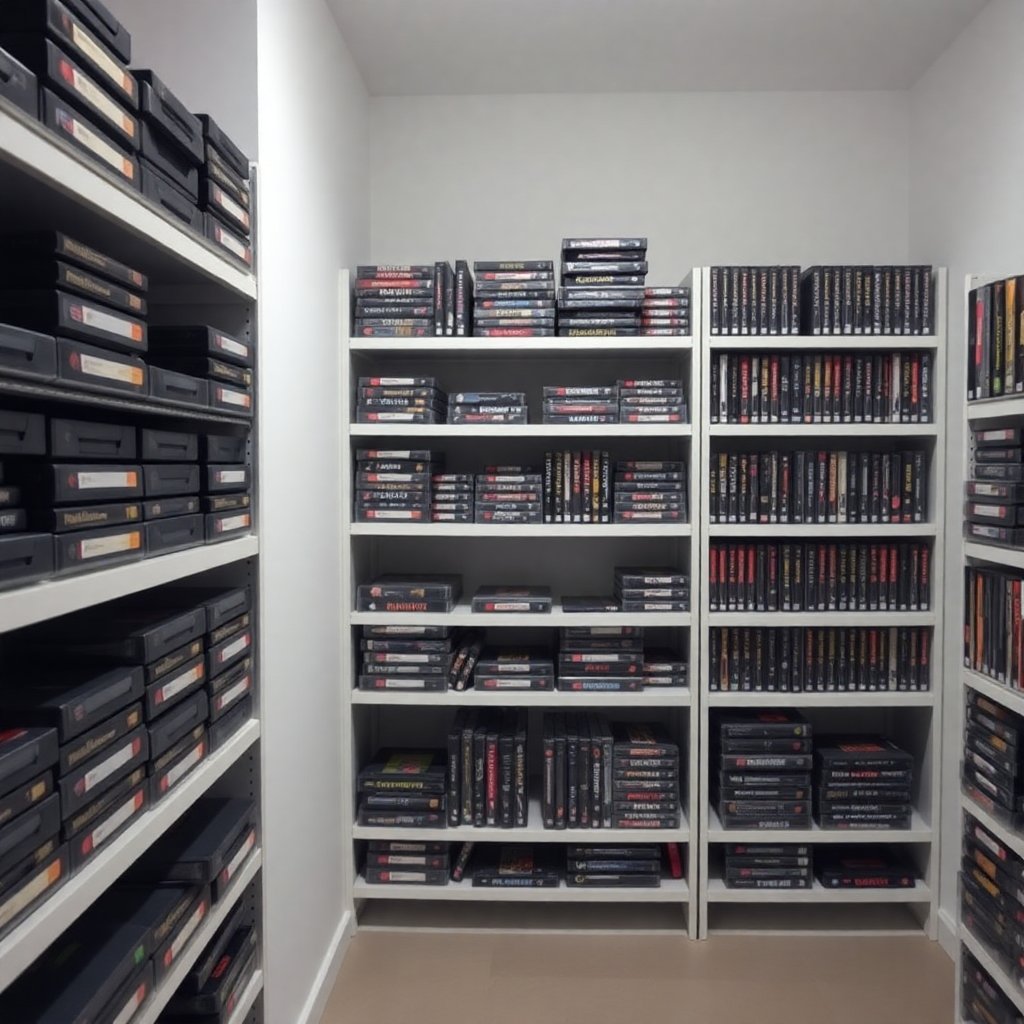
Every cartridge in your collection is a slow chemistry experiment, and time is not on your side. A boxed NES title that looks mint today can lose its crisp reds to a sunny window in a single summer. A save-battery left unchecked can weep acid onto a circuit board that no amount of money will un-corrode. The good news is that almost all of this decay is preventable, and the fixes are cheap compared to what a well-preserved collection is worth in 2026.
This is a practical, whole-collection storage guide. The market has grown into a multi-billion-dollar space, with recent estimates putting it around 4.18 billion dollars, and sealed and mint items now outperform loose copies by a wide margin. Condition is the entire game. Below is how to keep yours.
As an Amazon Associate we earn from qualifying purchases. Some links below are affiliate links, which helps keep this site running at no extra cost to you.
The four enemies you are actually fighting
Before buying a single storage bin, it helps to name what you are protecting against. Nearly all cartridge and box damage traces back to four culprits.
Light, specifically UV. Ultraviolet light fades pigments and weakens plastic polymers. Reds and yellows go first, which is why so many sun-exposed boxes drift toward a washed pink or brown. A cartridge label parked near a window for a year can lose a grade or two of visual condition permanently. This is the single most avoidable form of damage, and also the most common.
Humidity and moisture. Damp air invites mold on cardboard boxes and paper manuals, and it accelerates corrosion on the copper contacts inside a cartridge. Too dry is not ideal either, since very low humidity can make old plastics and labels brittle. The sweet spot most preservation-minded collectors aim for is roughly 40 to 55 percent relative humidity.
Heat. Warmth speeds up every chemical reaction working against you. It accelerates plastic breakdown, encourages solder and label adhesives to fail, and makes battery leakage worse. A stable, cool room beats an attic or garage every time.
The wrong plastics. This one surprises people. Storing games in the wrong material can actively harm them. According to guidance summarized in Armchair Arcade's collection-preservation piece, PVC-based sleeves and cases can off-gas and react with labels and inks over time. Safe long-term plastics are the acid-free ones: PET, polyethylene, and polypropylene.
Control the room before you control the shelf
The cheapest preservation upgrade is choosing the right room. An interior closet or a climate-controlled spare room beats a garage, attic, or basement in almost every case, because those spaces swing hardest in temperature and humidity across the seasons.
Aim for stable, not extreme. Consistency matters more than hitting a perfect number. A room that holds a steady 65 to 72 degrees Fahrenheit and 45 percent humidity year-round is better than one that is occasionally "ideal" but swings wildly. Each expansion-and-contraction cycle stresses plastics, adhesives, and solder joints.
Measure what you cannot see. You cannot manage humidity you are not tracking. A small digital hygrometer costs a few dollars and tells you whether you have a problem before mold does. Drop one on the shelf and check it for a couple of weeks.
→ Shop a digital hygrometer for storage on Amazon
If the air is damp, dry it. In humid climates, silica gel desiccant packs inside sealed bins are the low-effort fix, and the rechargeable kind pays for itself. For a whole damp room, a small dehumidifier is the real answer. If the air is bone dry in winter, back off the desiccant rather than adding any moisture source near the games.
Blocking UV: the highest-return move
If you do one thing from this article, block the light. UV damage is cumulative and irreversible, so an ounce of prevention genuinely beats a pound of cure here.
Keep displayed items out of direct and indirect sun. Even a bright north-facing room delivers enough UV over months to matter. Display pieces belong on an interior wall, away from windows.
Use UV-filtering enclosures for the good stuff. For graded slabs and your most valuable boxes, UV-resistant acrylic display cases are worth the money. They let you show the collection without slowly cooking it. For anything you are not displaying, the simplest UV protection is a closed, opaque cabinet or bin, since a cartridge in the dark gets zero UV exposure.
→ Shop UV-resistant display cases for games on Amazon
Protect boxes individually. Acid-free box protectors made from PET do double duty: they shield against dust and handling scuffs and add a barrier layer. Just confirm the product lists PET or polyethylene rather than PVC before you buy a case of them.
Cartridges: contacts, batteries, and safe sleeving
Cartridges are hardier than discs, but they have their own failure modes, and two of them can be catastrophic if ignored.
Contact corrosion. The copper edge connectors that a cartridge plugs in with will tarnish in humid or salty air, which is exactly why humidity control matters. Store carts in a stable, dry environment and they largely take care of themselves. If you are cleaning tarnished contacts before storage, the safe approach is isopropyl alcohol of 90 percent or higher on a swab, never an abrasive that scrapes the plating. Our Game Boy cartridge authentication guide walks through what a healthy board and contacts should look like if you want a reference before you start.
Save-battery leakage. This is the quiet collection-killer. Many SNES, Genesis, Game Boy, and other save-enabled carts hold a CR2032-style battery that, decades on, can leak and corrode the board underneath. Before long-term storage, it is worth checking your battery-backed titles and replacing any that look swollen or crusty. We cover the process in detail in the Game Boy Color battery replacement guide, and the same principles apply across systems.
Sleeve and separate. Individual acid-free plastic sleeves keep dust off labels and stop carts from rubbing against each other. Store them upright like books rather than stacked flat, which reduces pressure on labels and makes the collection easier to browse.
→ Shop acid-free cartridge sleeves and cases on Amazon
Discs and manuals need their own rules
Optical media fails differently. Disc rot, the gradual degradation of a disc's reflective layer, is driven by humidity, heat, and poor manufacturing, and once it starts it cannot be reversed. Store discs vertically in their cases, keep them cool and dry, and handle them by the edges. The same 40 to 55 percent humidity target that protects cartridges protects discs.
Paper is the most fragile part of many boxed sets. Manuals and inserts belong in acid-free sleeves, kept flat or gently upright, well away from moisture and light. A single damp episode can foxing-stain a manual that then drags down the value of an otherwise clean complete-in-box set.
Handling, labeling, and the maintenance habit
Storage is not a set-and-forget task, but the ongoing effort is small.
Handle clean and dry. Skin oils are mildly acidic and attract dust. Wash and dry your hands before handling valuable pieces, or wear thin cotton or nitrile gloves for graded and sealed items.
Do a check twice a year. Set a recurring reminder to spend an hour every six months walking the collection: glance at the hygrometer, look for any hint of mold or warping, and spot-check battery-backed carts for leakage. Early detection is the whole ballgame, because most catastrophic damage starts small and slow.
Label bins, not games. Never put tape or sticky labels directly on a cartridge or box. Label the storage bin or shelf instead, and keep a simple spreadsheet inventory so you know what you own and roughly what it is worth. If you are unsure how to assess condition in the first place, our complete-in-box condition grading guide gives you a consistent vocabulary for tracking it over time.
A simple starter kit
You do not need a museum budget to store a collection well. A sensible starting point looks like this: a digital hygrometer to monitor the room, a few rechargeable silica gel packs for sealed bins, acid-free PET box protectors for your best boxes, acid-free sleeves for loose carts, and a closed opaque cabinet or a set of lidded plastic totes for everything not on display. Add UV-resistant acrylic cases only for the specific pieces you actually want to show off.
The total outlay is modest, and it is trivial next to the value it protects. A collection that lives in a stable, dark, moderately dry space, gets a twice-yearly look, and never sits in PVC will still look sharp decades from now, while an identical collection in a sunny garage quietly loses grades every year.
The bottom line
Long-term preservation comes down to four moves: block UV, hold humidity in a stable middle band, keep things cool, and never store games in PVC. Layer on a quick battery check for save-enabled carts and a twice-a-year inspection, and you have covered essentially every common failure mode. Prices for mint and sealed items keep climbing precisely because so few survive in that state, so the collection you protect today is the one worth the most tomorrow. Start with the room, measure the air, kill the light, and the rest is easy.
As an Amazon Associate we earn from qualifying purchases. This article contains affiliate links; if you buy through them we may earn a small commission at no additional cost to you.