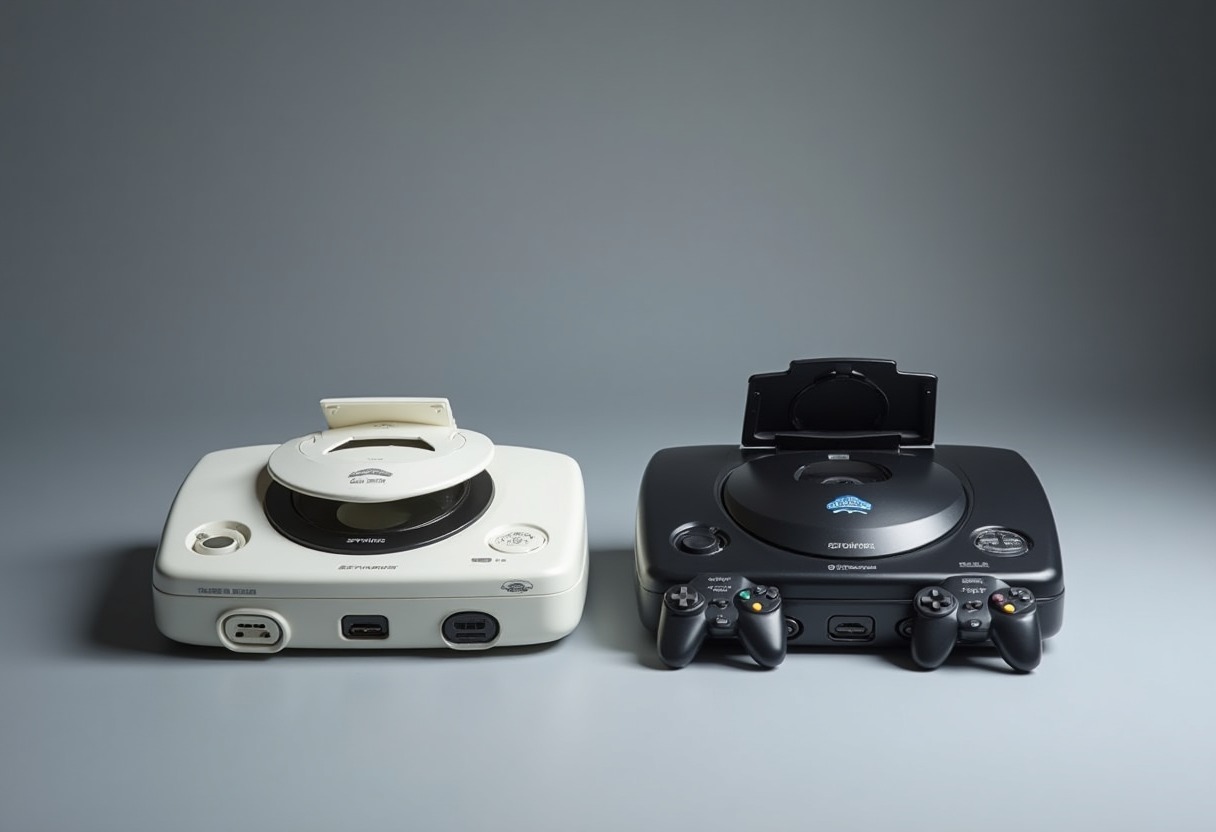
The Sega Saturn shipped in eleven distinct regional variants across three continents, each with different motherboard revisions, expansion bay configurations, and region-locking mechanisms that directly affect what games you can play. A Japanese white Saturn with a Video CD card slot isn't the same machine as a North American gray model, and knowing these differences before you hand over cash prevents expensive mistakes.
Why Saturn Model Knowledge Matters for Collectors
Most retro console variants matter primarily for completionism. The Saturn is different. Hardware revisions changed backward compatibility, controller support, and mod chip installation difficulty. Region variants determined expansion bay functionality and video output quality. Unlike Sega Genesis model differences where the changes were mostly cost-cutting measures, Saturn revisions addressed specific market needs and manufacturing challenges.
The Saturn launched in Japan on November 22, 1994, then North America on May 11, 1995, and Europe later that year. According to Sega's development documentation archived by GiantBomb, the rushed North American launch forced Sega to ship early production runs before finalizing the motherboard design. This created at least four distinct motherboard revisions in the first production year alone, each with different power consumption, heat output, and component layouts.
Japanese models came in white, gray (sold as "Hi-Saturn" through Hitachi), and later transparent cases. North American units shipped exclusively in gray. European models matched the NA gray design but included a different power supply and SCART-compatible video output. The PAL/NTSC difference isn't cosmetic — it changes compatibility with certain games and affects display quality on period-correct CRTs.
Japanese vs. North American vs. European Models
The three major regional variants each served different markets with hardware adjusted accordingly. Japanese Saturns targeted a market where CD players and multimedia expansion mattered. North American versions prioritized game performance and cost reduction. European models needed PAL video compliance and multi-region power compatibility.
Japanese Models (HST-0001 through HST-0019):
White plastic housing became the signature look. All Japanese units included a cart slot accessible from the top — critical for → Shop Sega Saturn Action Replay on Amazon functionality that bypasses region locks. The expansion bay on the rear accepted Video CD cards (HSS-0104), RAM expansion cartridges, and Netlink adapters. Early production runs (HST-0001) used higher-quality Sanyo CD drives that read burned discs more reliably than later revisions.
North American Models (MK-80000 and MK-80001):
Gray plastic only. Same cart slot as Japanese units, but shipped without Video CD capability advertised. The MK-80000 designation covered multiple motherboard revisions — VA0 through VA9 — with significant differences in capacitor placement and voltage regulation. Later MK-80001 models incorporated cost-reduced components that run hotter and fail more frequently. These units commonly develop PSU capacitor issues after 25+ years.
European/PAL Models (MK-80200):
Identical gray housing to NA units but with crucial differences under the hood. PAL video output at 50Hz instead of 60Hz. Different power supply rated for 220-240V. Some European releases received multi-language BIOS options. The expansion bay functioned identically to NA models. PAL region lock prevents playing NTSC discs without modification.
The Video CD expansion deserves special mention. Japanese consumers used Saturns as multimedia devices, playing Video CDs through the HSS-0104 card. This functionality never officially released in North America, though the hardware bay existed. Collectors hunting Japanese units specifically for VCD capability should verify the expansion bay includes the proprietary slot — late-model Japanese releases shipped without it as cost-cutting.
Hardware Revision Breakdown
| Model Code | Region | Motherboard | Notable Features | Collector Value | |------------|--------|-------------|------------------|-----------------| | HST-0001 | Japan | VA0/VA1 | Sanyo CD drive, best disc read compatibility, metal RF shield | Highest — premium for reliability | | MK-80000 (early) | NA | VA0-VA3 | Pre-cost-reduction components, better capacitors | High — fewer failures | | MK-80000 (late) | NA | VA4-VA9 | Cost-reduced, known PSU issues, plastic RF shield | Medium — requires inspection | | MK-80200 | Europe | VA SG | PAL video, different PSU, SCART output | Medium — region-specific appeal |
The motherboard revision matters more than the external model number. VA0 and VA1 boards used better capacitors from Panasonic and Nichicon. VA4 onward switched to cheaper Chinese capacitors that leak electrolyte after two decades. Opening the console to check the motherboard stamp saves you from buying a time bomb.
Early Japanese units also included higher-quality AV output components. Composite video on HST-0001 models shows measurably better color separation than late MK-80000 units. S-video output quality varies by revision — VA0 Japanese boards produce the cleanest signal, while late NA boards show more noise and color bleeding. For serious collecting, pair any Saturn with → Shop Sega Saturn S-video cable on Amazon to maximize picture quality on compatible displays.
Regional Lockout and Workarounds
Saturn region locking operates on two levels: disc region and BIOS region. Every game disc contains region code data checked at boot. The console BIOS must match that region or the disc won't load. Unlike PlayStation region locks that used simple boot checks, Saturn implemented hardware-level verification through the CD subsystem.
Action Replay Plus Cartridge:
The cleanest solution. → Shop Sega Saturn Action Replay on Amazon provides region bypass, 1MB/4MB RAM expansion, and cheat functionality in one package. Insert the cartridge, power on with any region disc, and the cartridge spoofs the correct region code. No permanent modification required. The 4MB RAM version unlocks compatibility with games like X-Men vs. Street Fighter and Marvel Super Heroes vs. Street Fighter that require expanded memory.
Mod Chips:
Permanent hardware modification that disables region checking entirely. Installation difficulty varies by motherboard revision. VA0 and VA1 boards require 12-wire installations with precision soldering to small through-holes. VA4+ boards simplified to 5-wire installs but still demand decent soldering skills. → Shop Sega Saturn mod chip on Amazon and expect to either handle surface-mount soldering yourself or pay a professional installer $60-120.
BIOS Swap:
Physically replacing the BIOS chip changes the console's region permanently. Japanese to NA conversions were common in the late 90s. This method works but destroys collectibility since it modifies original hardware. Collectors should avoid BIOS-swapped units unless specifically noted and priced accordingly.
Region locks don't affect save data or controller compatibility. A Japanese → Shop Sega Saturn 3D controller on Amazon works perfectly on a NA console. Save files from any region transfer freely via cartridge backup. The only compatibility concern is RAM expansion requirements — Japanese games requiring 1MB or 4MB RAM won't run on hardware lacking the expansion, regardless of region bypass.
Controller and Accessory Compatibility Across Regions
All standard Saturn controllers use the same physical connector and electrical protocol across regions. A Japanese white controller plugs directly into a North American console with full functionality. The six-button layout, analog 3D pad, twin-stick controllers, light guns, racing wheels — all region-agnostic at the hardware level.
The Mission Stick flight controller (HSS-0104) shipped in Japan only but works flawlessly on any Saturn. Same for the Virtua Stick arcade controller and Virtua Gun. European steering wheels function on Japanese units. The only limitation appears with software — Japanese games programmed for specific controller types may not recognize NA controller model numbers, but this affects game compatibility more than hardware function.
Backup memory cartridges follow the same standard. Japanese backup carts store saves from any region. The data format remains identical across territories. Action Replay cartridges manufactured for one region function perfectly in others since they override region checks during boot.
Video cables represent the only compatibility concern. Japanese Saturns output the same composite, S-video, and RGB signals as NA units, but European models use different pinouts for SCART compatibility. The Saturn never received component or VGA output officially — those require modern adapters. For connecting to contemporary displays, see our guide to NES Sega Modern TV HDMI Guide for adapter recommendations.
What Collectors Overlook When Buying
Expansion Bay Covers:
Most used Saturns arrive missing the expansion bay cover. This rectangular plastic piece protects the expansion port on the console's rear. Without it, dust infiltrates the connector pins and contacts. Replacement covers cost $15-30 alone. Check photos before purchasing or negotiate price adjustments.
Battery Holder Condition:
The CR2032 battery holder on the motherboard cracks with age. Corroded battery holders leak acid onto nearby traces, creating expensive repair situations. Sellers rarely photograph the battery compartment. Ask for a photo showing the battery holder intact before committing to expensive units.
Laser Assembly Wear:
CD laser mechanisms degrade with use. A Saturn that boots but struggles to read discs often has a worn laser assembly. Replacements cost $40-80 for the part, plus installation expertise. Test the console with multiple discs if buying locally — one game loading doesn't confirm full functionality. Burned CD-Rs provide the hardest test since they require stronger laser output than pressed discs.
Controller Port Integrity:
Rough handling breaks the plastic tabs inside controller ports. Controllers that wiggle loosely or disconnect during gameplay indicate damaged ports. This repair requires disassembly and plastic welding or port replacement. Budget another $30-50 to fix per port.
Disc Drive Lid:
The front-loading disc tray mechanism uses small plastic gears that strip over time. A tray that won't open or close smoothly needs gear replacement. Some units require complete disc drive disassembly to access the gear assembly. Factor this into your offer if the seller mentions tray issues.
For console condition assessment beyond basic functionality, our Complete CIB Retro Game Condition Grading Guide covers the standard grading metrics collectors use to evaluate both loose consoles and complete-in-box examples.
FAQ
What's the most reliable Sega Saturn model for long-term collecting?
Japanese HST-0001 units with VA0 or VA1 motherboards offer the best build quality and longest operational life. These early production runs used Sanyo CD drives and premium capacitors that outlast later revisions. Expect to pay $120-180 for a tested working unit versus $60-100 for later NA models. The reliability premium justifies the cost if you're building a collection for actual gameplay rather than display. Combined with an Action Replay cart for region bypass, a Japanese VA0 unit plays the entire Saturn library without modification while maintaining maximum hardware longevity.
Can I play North American games on a Japanese Saturn without modifications?
Yes, using an Action Replay Plus cartridge inserted in the top slot. The cartridge spoofs region codes during disc boot, allowing Japanese hardware to run NA and European games without BIOS modification or mod chip installation. The 4MB RAM version adds compatibility with RAM-dependent titles like Marvel Super Heroes vs. Street Fighter. Action Replay carts cost $40-80 used but preserve the console's original hardware completely. This approach maintains collectibility while providing full cross-region functionality.
Do PAL Saturn consoles play NTSC games at the correct speed and resolution?
Not without modification. PAL consoles output 50Hz video regardless of disc region, causing NTSC games to run roughly 17% slower with borders on compatible displays. Region bypass through Action Replay or mod chip allows PAL hardware to load NTSC discs, but the PAL BIOS forces 50Hz output. Correcting this requires BIOS replacement with a Japanese or NA chip, which changes the console's region permanently. Collectors in PAL territories seeking proper NTSC compatibility should consider Japanese or NA hardware instead of modifying PAL units.
How do I identify which motherboard revision is inside a used Saturn?
Open the console and check the motherboard stamp near the expansion port. The revision code appears as "VA" followed by a number (VA0, VA1, VA4, VA9, etc.) or "VA SG" for European models. Japanese units may show "HST" prefixes corresponding to the external model code. This requires removing six screws from the bottom case and carefully lifting the top shell. The motherboard stamp sits clearly visible once opened. Verify the revision before purchasing expensive units since early revisions command premium prices due to superior component quality and reliability.
Are there Saturn models with built-in region-free capabilities?
No official models shipped with region-free BIOS from Sega. All retail units enforce region locks through both disc checking and BIOS verification. Third-party modified consoles occasionally surface with region-free BIOS chips installed, but these represent aftermarket modifications that reduce collectibility. Some late Japanese units received unofficial BIOS mods during the console's active lifespan, creating gray-market "region-free" versions sold through import shops. These modified units appear identical externally but contain replaced BIOS chips. Collectors should verify BIOS originality when buying premium Japanese models to ensure authentic hardware.
The Saturn Demands Homework Before Purchase
Three decades after launch, buying any Sega Saturn requires understanding which specific revision you're actually getting, not just which region or color you prefer.
Some links on this page are affiliate links. We may earn a small commission if you purchase through them, at no extra cost to you.
As an Amazon Associate we earn from qualifying purchases. This article contains affiliate links; if you buy through them we may earn a small commission at no additional cost to you.