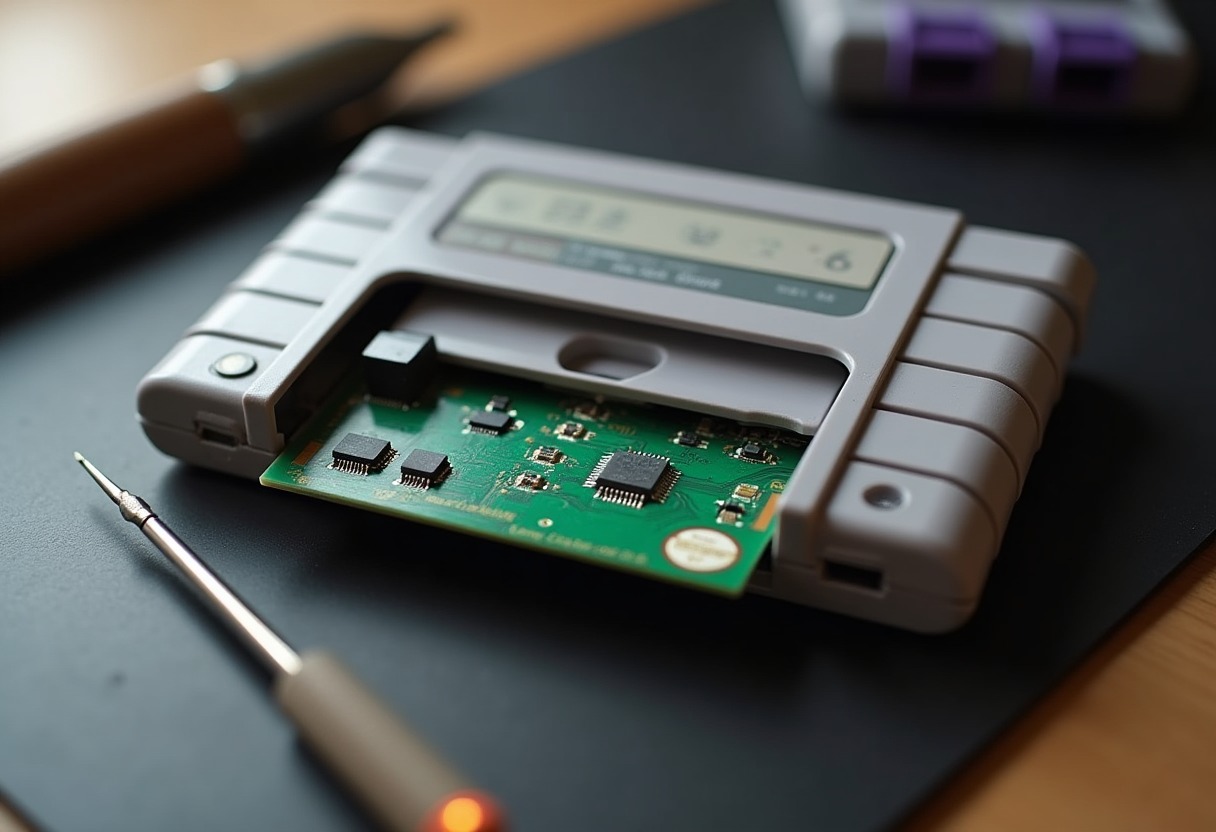
The chip configuration inside an SNES cartridge determines whether you own an early production run worth documenting or a common later revision—and you can't tell which without opening the shell. ROM revision differences affect gameplay bugs, speedrun strategies, and authentication confidence, yet most collectors never look past the label.
Why SNES Chip Identification Matters for Collectors
Nintendo manufactured SNES games across multiple production runs between 1991 and 1998, changing ROM chips, mappers, and board layouts to reduce costs or fix bugs. According to Wikipedia's SNES development documentation, the console's architecture allowed various memory mapping configurations, which manufacturers exploited differently across regions and release windows.
Early production cartridges often used larger ROM chips than necessary—Nintendo hadn't yet optimized component costs. Later revisions switched to smaller, cheaper chips or combined multiple functions onto single ICs. These changes create distinct board variants that collectors track for three reasons: authenticating expensive games against reproductions, identifying first-print cartridges for completionist sets, and verifying ROM versions that affect gameplay.
The board number stamped on the PCB (like SHVC-1A3M-01 or SNS-YI-USA) tells you the manufacturing period and component layout. Combined with ROM chip date codes, you can pinpoint production windows within months. This matters most for valuable SNES titles where reproduction carts flood the market using modern components that fail close inspection.
Common SNES Cartridge PCB Types and Their Components
SNES cartridges use three primary board layouts: standard ROM-only, ROM-plus-RAM for save functionality, and enhancement chip configurations like SuperFX or SA-1. The board type appears on the PCB silkscreen and dictates component placement.
Standard ROM boards (SHVC-1A0N, SNS-YI-USA) contain only ROM chips and the CIC lockout chip. Games like Super Mario World and The Legend of Zelda: A Link to the Past used these simple configurations. You'll find one or two mask ROM chips labeled with Nintendo part numbers (typically NMB prefix) and production date codes in YYWW format—year and week.
Battery-backed SRAM boards (SHVC-1A3M, SNS-AAA-USA) add a 62256 or similar 8KB SRAM chip, a coin cell battery (CR2032 or CR2025), and the MM1026 battery monitor IC. The SRAM chip stores save data; the battery keeps it alive when the cartridge isn't powered. RPGs like Final Fantasy III and Chrono Trigger use this layout. Check our Game Boy Color Battery Replacement Guide for related save battery maintenance techniques applicable across platforms.
Enhancement chip boards vary wildly. SuperFX boards (SHVC-2P3B, SNS-R4-USA) for Star Fox and Yoshi's Island include the GSU-1 or GSU-2 coprocessor and additional SRAM for frame buffering. SA-1 boards (SHVC-BA5M, SNS-E4-USA) for Super Mario RPG pack a 10MHz coprocessor that runs faster than the SNES CPU itself. These specialty boards command premium prices because reproductions can't replicate the coprocessor functionality accurately.
Identifying ROM Chip Markings and Date Codes
ROM chips carry three critical markings: the Nintendo part number, the manufacturer code, and the date stamp. A typical chip reads something like "© Nintendo NMB 9424 E" across multiple lines.
The NMB prefix indicates Nintendo's internal part numbering. The four-digit date code—9424 in this example—breaks down to week 24 of 1994. Early production runs cluster in the first 6-12 months after a game's release date; anything manufactured years later suggests a reprint or Greatest Hits version.
Manufacturer codes vary: Sharp (♦ symbol or SH prefix), Toshiba (TC prefix), NEC (μPD prefix), or Macronix (MX prefix). Sharp manufactured most first-party Nintendo titles during the SNES peak years, while later budget reprints often switched to cheaper Macronix chips. This doesn't affect functionality but helps date production runs.
To inspect these markings properly, you need a digital magnifier loupe with at least 10x magnification. The date codes on some chips wear down or sit at angles that make them illegible without proper lighting and magnification.
Opening cartridges requires a gamebit screwdriver set with 3.8mm and 4.5mm bits for the security screws Nintendo used. Work on an anti-static work mat to prevent ESD damage to the chips—ROM ICs can develop latent failures from static discharge that manifest as glitches months later.
SNES ROM Revision Differences That Affect Gameplay
ROM revisions fix bugs, alter difficulty, or change regional content. Speedrunners care intensely about these differences because specific revisions enable glitches that save minutes in optimized runs.
Super Metroid exists in three known revisions: JPN 1.0, USA 1.0, and USA 1.1. The USA 1.1 revision fixed the Zebetite skip glitch, making it useless for speedruns. Collectors targeting speedrun-viable carts specifically hunt USA 1.0 boards, which you can only verify by opening the shell and checking the ROM chip date code against the game's North American release window.
The Legend of Zelda: A Link to the Past has 1.0, 1.1, and 1.2 revisions. Version 1.0 allows the fake flippers glitch for sequence breaking; Nintendo patched this in 1.1. Version 1.2 primarily addressed regional text differences. The board number stays the same across revisions—only the ROM chip date code reveals which version you own.
Street Fighter II Turbo received multiple revisions balancing character moves. Early carts have exploitable infinite combos; later revisions rebalanced frame data. Tournament players seeking legal practice carts need specific revisions, creating niche collector demand.
SNES Board Variant Comparison Table
| Board Type | Example Games | Key Components | Authentication Notes | |------------|---------------|----------------|---------------------| | SHVC-1A0N / SNS-YI-USA | Super Mario World, F-Zero | ROM chip(s), CIC | Simplest to verify; reproductions easily spotted by cheap ROM chips and incorrect date codes | | SHVC-1A3M / SNS-AAA-USA | Final Fantasy III, Chrono Trigger | ROM, SRAM, battery, MM1026 | Check battery brand (Panasonic/Sony original; generic in repos), SRAM chip manufacturer | | SHVC-2P3B / SNS-R4-USA | Star Fox, Yoshi's Island | ROM, SuperFX (GSU), SRAM | GSU chip extremely difficult to counterfeit; presence of genuine GSU-1/2 confirms authenticity | | SHVC-BA5M / SNS-E4-USA | Super Mario RPG, Kirby Super Star | ROM, SA-1, SRAM | SA-1 coprocessor bears S-DD1 silkscreen; reproductions lack functional SA-1 and exhibit slowdown |
This table covers the four most common board families. Specialty configurations like S-DD1 compression boards (Star Ocean, Street Fighter Alpha 2) or DSP-enhanced games (Pilotwings, Super Mario Kart) follow similar identification principles: the enhancement chip itself proves authenticity because reproductions substitute cheaper components that produce different gameplay characteristics.
Essential Tools for SNES Cartridge Authentication
Beyond the basic gamebit driver and magnifier, serious collectors stock electronic component storage boxes to organize removed screws and document findings. Label each compartment with the game title and board type—when you're comparing multiple copies of the same game across different lot purchases, organization prevents mix-ups.
A SNES cartridge opener tool with shell-gripping teeth speeds up inspections and reduces the risk of stripped screws. The security screws in 30-year-old carts often have corroded heads from humidity exposure; cheap bits strip these instantly, while quality tools with hardened tips bite cleanly.
Photography matters for documentation. Photograph the PCB top and bottom at high resolution before and after cleaning. These images prove provenance if you later sell the cart and serve as reference when comparing against questionable listings online. A dated photo set showing original components refutes any later claims that you swapped boards.
For collectors building reference databases, spreadsheet templates tracking board numbers, ROM date codes, and chip manufacturers create pattern recognition. After documenting 50+ copies of Super Mario World, you'll spot the outlier immediately—the reproduction cart with a 2018 date code or the wrong SRAM chip type.
Advanced Identification: CIC Chip Variants and Regional Lockout
The CIC (Checking Integrated Circuit) chip handles regional lockout between NTSC and PAL systems. SNES carts contain either a SNES-CIC-USA, SNES-CIC-EUR, or SNES-CIC-JPN chip, which must match the console's regional variant to boot.
Japanese Super Famicom carts use SNES-CIC-JPN chips on different board layouts (SHVC prefix instead of SNS). The physical shell shape differs slightly—SFC carts have rounded corners while SNES carts have sharper edges—but swapping the internals works if the CIC matches your console region.
Reproduction carts often use incorrect CIC chips or universal bypass chips that work on any region. A genuine North American cart absolutely must have a SNES-CIC-USA chip with Nintendo's logo and part number clearly stamped. Universal CICs indicate reproduction or a board swap from a different region donor cart.
Some collectors modify consoles to accept any region cart by disabling the CIC lockout—similar to the techniques described in our Best Retro Consoles 2026 guide for playing import games. This doesn't affect cart value, but knowing which CIC variant your cart contains matters for resale accuracy and playability claims.
Spotting Reproduction Boards Through Component Analysis
Reproduction SNES carts reveal themselves through anachronistic components. Modern EEPROM or flash chips didn't exist during the SNES production era. Genuine carts exclusively used mask ROM technology—one-time-programmable chips manufactured with the data physically etched into silicon.
Check the ROM chip type against the production date. A cart claiming to be from 1993 with a flash chip dated 2015 is obviously reproduction. Even if the date codes are plausible, modern chips have different physical characteristics: thinner packages, different pin spacing, or surface-mount technology instead of through-hole mounting.
SRAM chips in reproduction carts often come from secondary manufacturers with unfamiliar brand names. Genuine Nintendo boards used consistent SRAM suppliers: Toshiba, Sharp, or Hitachi. An unknown Chinese manufacturer's SRAM chip didn't appear in legitimate 1990s production.
Battery types matter too. Original carts used Panasonic CR2032 or Sony CR2025 cells with printed date codes. Reproductions use generic batteries without branding or batteries with implausibly recent manufacture dates. A 2022 battery in a supposedly untouched 1994 cart proves someone opened and serviced it—or it's entirely reproduction.
The PCB material itself differs. Genuine Nintendo boards use specific green or blue solder mask colors with high-quality FR-4 substrate. Reproduction boards often use cheaper materials with different colors, thinner substrates, or rougher surface finishes. Hold an original board next to the suspect—the difference becomes obvious.
Market Value Impact of ROM Revisions and Board Types
First-revision carts with specific glitches command premiums in speedrun communities. A verified Rev 1.0 Super Metroid cart sells for 20-30% more than later revisions to runners who need practice carts matching tournament-legal versions. This premium only applies if you can prove the revision through opened inspection photos.
Enhancement chip carts hold value better than ROM-only equivalents because reproductions struggle to replicate coprocessor functionality. A genuine SuperFX cart maintains authenticity confidence; a ROM-only cart requires more scrutiny. When evaluating purchases from our Best SNES Games to Collect list, factor in authentication difficulty—SuperFX titles like Star Fox practically self-authenticate.
Early production run boards with Sharp ROM chips and first-year date codes interest completionist collectors building release-window accurate sets. These don't command huge premiums outside extremely rare titles, but documented first-print examples differentiate serious collections from casual accumulations.
Regional variant boards create cross-market opportunities. Japanese Super Famicom carts often cost less than North American equivalents for the same game. Collectors comfortable with CIC chip swapping or region-free console modifications access cheaper sources for expensive titles. This practice exists in a gray area—it's not reproduction, but it's not stock configuration either. Disclosure matters for resale ethics.
Documentation Standards for Serious Collectors
Photograph every opened cart's PCB with the game label visible in frame, proving the board matches the shell. Include a handwritten reference card with your collection identifier and date in each photo. This creates verifiable provenance chains for high-value items.
Maintain a database spreadsheet recording board numbers, ROM date codes, chip manufacturers, and any anomalies. Cross-reference this against known production data from collector communities and authenticity guides like our Game Boy Advance Cartridge Authentication Guide, which covers similar verification principles.
When selling documented carts, include the PCB photos and data spreadsheet excerpt in listings. Buyers pay premiums for carts with established authentication records. A $200 game with full documentation sells faster than an identical cart at $180 without proof.
Store opened carts in ESD-safe bags after inspection if you're building a reference collection rather than a player collection. Static discharge risks increase every time you handle bare PCBs. For display collections, consider acrylic cases that show the board through a window while maintaining protection—similar to how serious collectors approach other platforms covered in our Complete CIB Retro Game Condition Grading Guide.
FAQ
How do I tell if my SNES cart is reproduction without opening it? Weight and shell quality provide initial clues—reproductions often feel lighter and have rougher plastic molding with visible seam misalignments. The label texture differs too: original labels have specific printing characteristics and age wear patterns that reproductions struggle to replicate. These signs aren't definitive, but they flag candidates for closer inspection.
Do ROM revision differences affect normal gameplay or only speedruns? Most revisions fix minor bugs that casual players never encounter or notice. Some revisions adjust difficulty slightly—Street Fighter II Turbo balancing changes matter in competitive play but not single-player arcade mode. Only speedrunners and competitive players need specific revisions; collectors care about revisions for documentation and value tracking purposes.
Can I damage the ROM chip by opening the cartridge repeatedly? The ROM chips themselves aren't fragile, but repeated shell openings risk stripping security screws or stressing the PCB through flexing. The bigger risk comes from ESD—handle boards on anti-static mats and discharge yourself by touching a grounded metal object before touching components. Limit openings to authentication checks and necessary maintenance rather than casual curiosity.
Which SNES games have the most valuable early ROM revisions? Super Metroid Rev 1.0, Earthbound early production boards with specific ROM configurations, and championship cartridges with unique board layouts command the highest premiums for revision-specific collecting. Street Fighter II variants and speedrun-critical Zelda revisions have smaller but real value differences. The premium only matters if you document and prove the revision through photos.
Are PAL SNES boards interchangeable with NTSC boards? The board layout is physically compatible—you can swap a PAL board into an NTSC shell—but the CIC chip region lock prevents the cart from booting on a mismatched console. Some PAL games have different ROM content (language translations, gameplay changes) beyond just regional lockout. Swapping boards requires matching the CIC chip to your console region or using a region-free modified console.
Closing Thought
The difference between a common cart and a documented first-print rarity lives inside the shell where most collectors never look—crack them open, and you'll know exactly what you own.
Some links on this page are affiliate links. We may earn a small commission if you purchase through them, at no extra cost to you.
As an Amazon Associate we earn from qualifying purchases. This article contains affiliate links; if you buy through them we may earn a small commission at no additional cost to you.